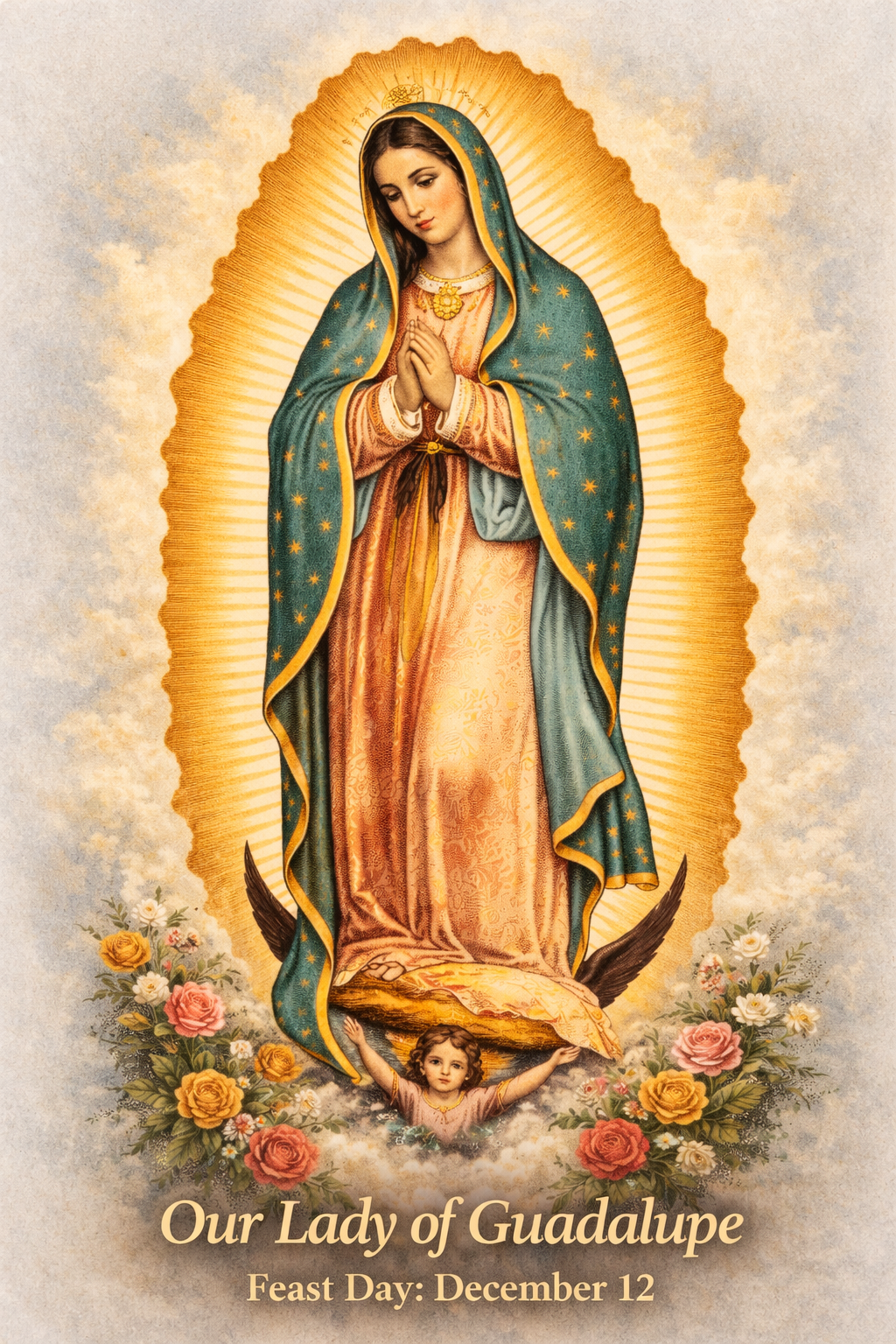
The apparition of 1531
On the morning of December 9, 1531, Juan Diego — a recently baptized Nahua man in his fifties — was walking past Tepeyac Hill near Mexico City when he heard music and a woman's voice calling his name. A young woman appeared to him, surrounded by light, and identified herself as the Virgin Mary. She asked him to go to the local bishop and request that a chapel be built on that hill.
Bishop Juan de Zumárraga was skeptical. He asked for a sign. On December 12, Juan Diego returned to the hill and found it covered in Castilian roses — flowers that did not grow in that region, in the middle of winter. He gathered them in his tilma — his rough-woven cloak — and brought them to the bishop. When he opened the cloak, the roses fell to the floor. But it was not the roses that stopped everyone in the room. On the fabric of the tilma was an image of the Virgin Mary, perfectly formed, that no one had put there.
The tilma — a miracle that endures
Nearly five centuries later, the tilma of Juan Diego still hangs in the Basilica of Our Lady of Guadalupe in Mexico City. It has never been retouched or restored. Scientific studies have found no brush strokes, no sizing on the fabric, and no natural explanation for how the image was formed. The cloth itself, which would normally deteriorate in a matter of decades, shows no signs of decay.
In 1791, nitric acid was accidentally spilled on part of the tilma. The damage repaired itself over the following ten years. In 1921, an anti-clerical activist hid a bomb in flowers placed beneath the image. The explosion destroyed a marble altar rail and bent a large brass crucifix — but left the tilma untouched.
"Am I not here, I who am your mother? Are you not under my shadow and protection?"
Why she appeared as an indigenous woman
One of the most theologically significant aspects of the apparition is how Our Lady of Guadalupe appeared. She did not come as a European queen. She appeared as a young mestiza or indigenous woman — dark-haired, dark-skinned, dressed in the colors and symbols of Aztec cosmology. She spoke to Juan Diego in Nahuatl, his own language. She stood before the sun, symbolizing that she was greater than the sun god. She stood on the moon, symbolizing she was greater than the moon god. She wore a maternity band around her waist — the Aztec symbol of a woman with child.
The message was unmistakable to the indigenous people of Mexico: this was not the God of the Spanish conquerors imposing a foreign religion. This was the Mother of God coming to them, in their image, in their language. In the years following the apparition, an estimated nine million people converted to Christianity — one of the largest mass conversions in history.
Patroness of the Americas
Pope Pius XII declared Our Lady of Guadalupe the Patroness of the Americas in 1945. Pope John Paul II visited her shrine three times and declared her the Patroness of all the Americas and the Star of the New Evangelization. Juan Diego himself was canonized in 2002 — the first indigenous saint of the Americas.
Today the Basilica of Our Lady of Guadalupe in Mexico City receives approximately 20 million pilgrims per year, making it the most visited Catholic pilgrimage site in the world after the Vatican.
Why Catholics pray to Our Lady of Guadalupe
Her intercession is sought across an enormous range of intentions, but several stand out as especially common:
- Protection of families and children
- Prayers for the unborn and for mothers
- Hope and comfort during grief or loss
- Strength for immigrants and those far from home
- Cultural and spiritual identity — especially among Hispanic and Latin American Catholics
- Preparation for her feast day on December 12