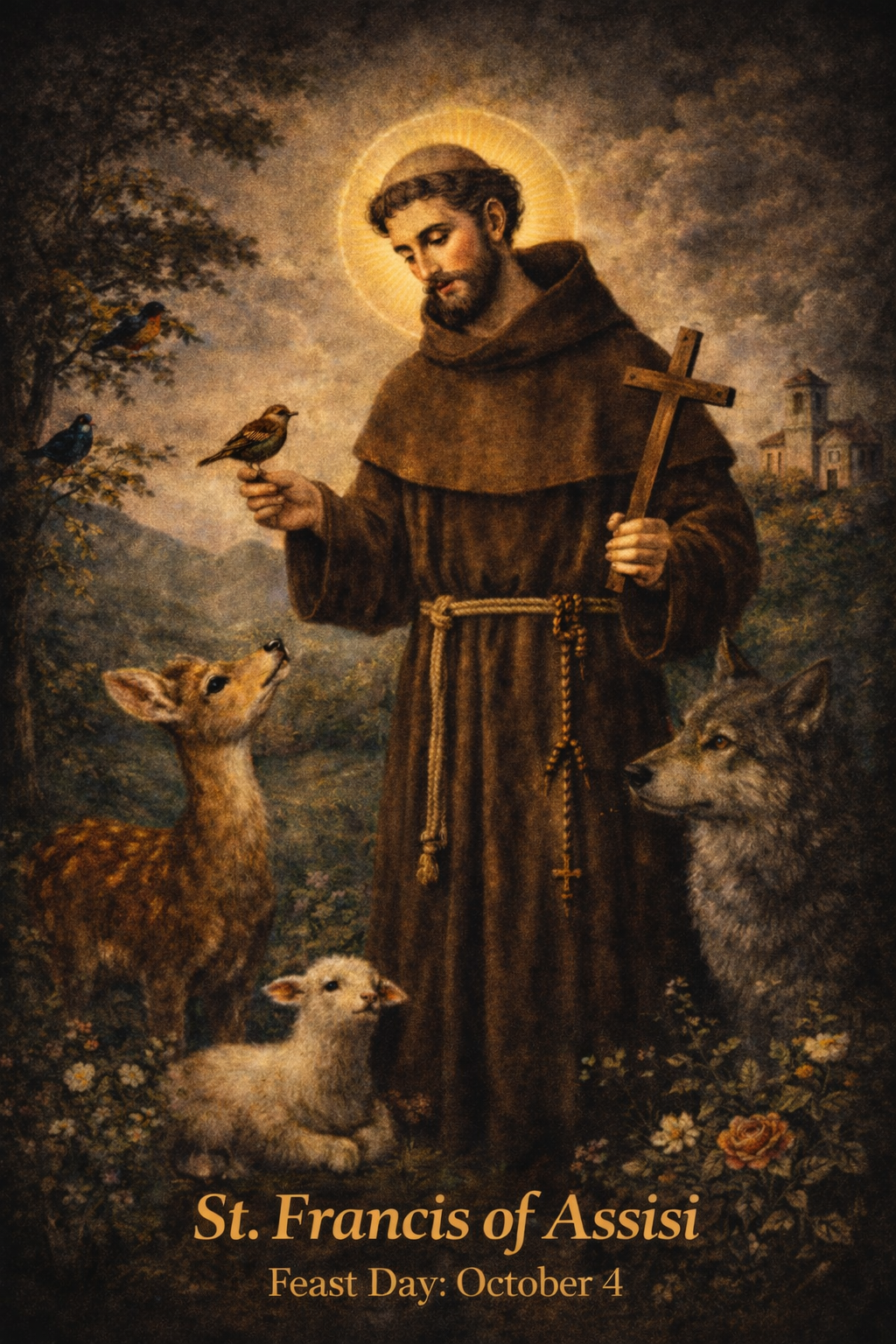
Who was St. Francis of Assisi?
Giovanni di Pietro di Bernardone was born around 1181 in Assisi, a hilltop town in central Italy. His father Pietro was a prosperous cloth merchant, and Francis grew up with every advantage — fine clothes, good food, friends, parties, and ambitions of knighthood. He was charming, generous, and well-liked. He was also, by his own later account, completely empty.
After a year as a prisoner of war in Perugia and a serious illness, something began to shift. He started giving money to the poor, then spending time with lepers — the most feared and shunned people of his era. Then one day, praying before a crumbling crucifix in the neglected chapel of San Damiano, he heard a voice: "Francis, go and repair my house, which as you can see is falling into ruin."
He took it literally at first, selling cloth from his father's warehouse to fund the repairs. His father was furious. The resulting confrontation ended with Francis standing before the bishop of Assisi, removing every piece of clothing his father had given him, handing it back, and saying he would have no father but God in heaven. Then he walked away — into a life of poverty, prayer, and radical joy that would change the Church forever.
Founding the Franciscans
Francis did not set out to found a religious order. He simply began living the Gospel as literally as he could — owning nothing, preaching peace, caring for lepers and outcasts — and people started following him. Within a few years there were dozens of brothers. He wrote a simple rule of life based on the words of Christ in the Gospels and went to Rome to ask Pope Innocent III to approve it.
The Pope was initially skeptical. A group of wandering preachers with no property and no income seemed impractical at best. But Innocent III had a dream in which a small, ragged man held up a basilica that was falling. He recognized Francis, approved the rule, and the Franciscan order was born.
Today the Franciscan family — including the Order of Friars Minor, the Poor Clares (founded with St. Clare of Assisi), and the Third Order for laypeople — numbers in the hundreds of thousands worldwide.
"Start by doing what is necessary, then do what is possible, and suddenly you are doing the impossible."
His love for creation
Francis is perhaps most widely known today for his relationship with the natural world. He preached to birds. He negotiated with a wolf that had been terrorizing a village. He called the sun his brother and the moon his sister. His great poem, the Canticle of the Creatures, written near the end of his life when he was nearly blind, is one of the earliest surviving works of Italian literature — a hymn of praise to God through every element of creation.
This was not sentimentality. For Francis, creation was not separate from God — it was the handiwork of God, worthy of reverence. In 1979, Pope John Paul II formally recognized what Catholics had known for centuries and declared St. Francis the patron saint of ecology. Pope Francis, elected in 2013, took his name directly in honor of this tradition.
The stigmata
In September 1224, Francis withdrew to Mount La Verna in Tuscany for a forty-day fast before the feast of Michaelmas. While deep in prayer, he had a vision of a seraph — a six-winged angel — bearing the image of the crucified Christ. When the vision ended, the wounds of Christ had appeared on his body: in his hands, his feet, and his side. He became the first person in recorded history to receive the stigmata.
Francis bore the wounds for the remaining two years of his life. He tried to hide them, especially his hands, but they were witnessed by many of his brothers. When he died on October 3, 1226, those present reported that the wounds were clearly visible. He was canonized less than two years later — one of the fastest canonizations in Church history.
Why people are drawn to St. Francis
Francis is unusual among the saints in that his appeal extends well beyond Catholicism — or even Christianity. He is beloved by people of many faiths and none, drawn to his simplicity, his gentleness, his refusal to accumulate, and his instinct that the poor, the sick, the outcast, and the natural world all deserve the same dignity.
Catholics especially turn to him when:
- Seeking peace — in their own heart or in a difficult relationship
- Struggling with materialism or a desire for a simpler life
- Praying for animals or asking for a blessing of pets
- Caring for creation and seeking a spirituality of the environment
- Going through a conversion or a major life change
- Wanting to pray for the poor, the homeless, or the marginalized
October 4 — Feast day and Blessing of the Animals
St. Francis's feast day on October 4 is one of the most widely observed in the Catholic calendar — and one of the most joyful. The tradition of blessing animals on or near his feast day is practiced in parishes around the world, from small rural churches to the Cathedral of St. John the Divine in New York City, where horses, camels, and even elephants have been brought through the doors for the annual blessing.
It is a fitting tribute to the man who saw every creature as a brother or sister in God's family.