Catholic Devotion
Padre Pio
A humble friar who bore the wounds of Christ for fifty years, heard confessions for up to eighteen hours a day, and became one of the most beloved saints of the modern era. Here is the life of Padre Pio, his famous prayer, and why millions turn to him in times of suffering.
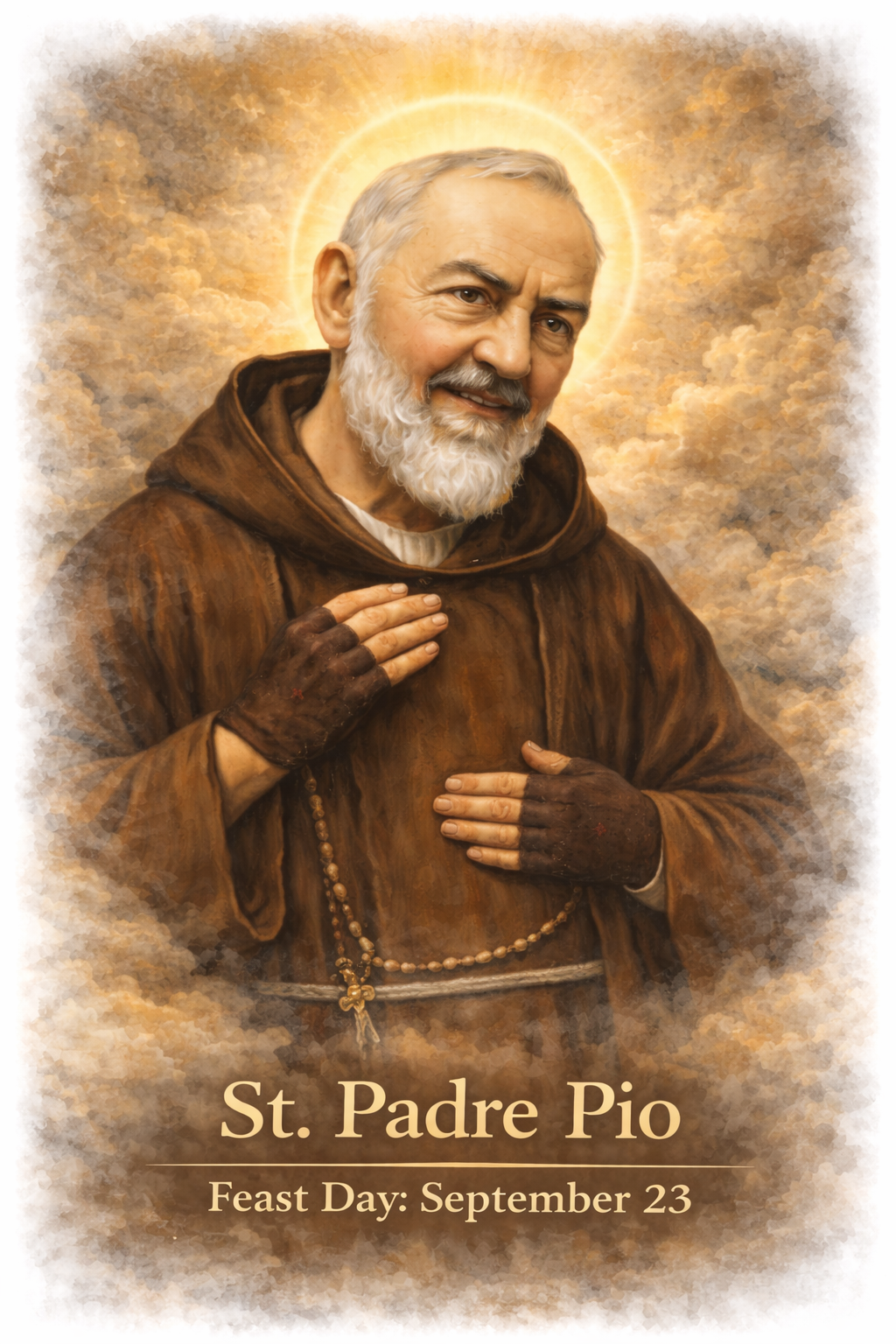
Feast Day: September 23
Canonized: 2002
Franciscan Capuchin
Who was Padre Pio?
Francesco Forgione was born on May 25, 1887, in Pietrelcina, a small town in southern Italy. From childhood he experienced visions and mystical phenomena that set him apart. At fifteen he entered the Franciscan Capuchin order, was ordained a priest in 1910, and took the name Fra Pio — Padre Pio.
He spent most of his priestly life at the friary of San Giovanni Rotondo, where he became known not just for the stigmata but for something perhaps even more extraordinary: his pastoral presence. People traveled from across the world to make their confession to him, often reporting that he knew their sins before they had spoken them.
The stigmata
On September 20, 1918, while praying before a crucifix, Padre Pio received the visible stigmata — the five wounds of Christ in his hands, feet, and side. He bore them continuously for fifty years, until his death in 1968. They were examined by physicians and Church authorities on multiple occasions and were never medically explained.
For Padre Pio, the stigmata were not a source of pride but of suffering. He frequently asked God to take them away — or at least to make them invisible — which, according to witnesses, they did for a period. He saw his suffering as a participation in the Cross, a way of interceding for souls.
"Pray, hope, and don't worry. Worry is useless. God is merciful and will hear your prayer."
His gifts and charisms
Padre Pio is one of the most extensively documented mystics in modern Catholic history. Among the phenomena widely reported and verified by witnesses were:
- Bilocation — being seen in two places at once
- Prophecy — foretelling future events with accuracy
- Reading of souls — knowing penitents' sins before confession
- Healing — numerous miraculous recoveries attributed to his intercession
- The odor of sanctity — a sweet fragrance associated with his presence
His cause for canonization was opened in 1969, just one year after his death — an unusually swift timeline — and Pope John Paul II, who had personally visited Padre Pio as a young priest, canonized him on June 16, 2002.
Why people pray to Padre Pio
Padre Pio is one of the most invoked saints for healing, both physical and spiritual. His life was defined by suffering willingly accepted, and this is precisely why those who are sick, grieving, or struggling find such connection with him — he is not a distant, triumphant figure, but a man who knew pain deeply and carried it with grace.
Catholics especially turn to him when:
- Facing a serious illness — their own or someone they love
- Struggling to find meaning in suffering or chronic pain
- Going through grief, loss, or depression
- Seeking healing that medicine has not provided
- Wanting to go to confession or return to the sacraments
- Feeling far from God and needing to be drawn back
His legacy today
Padre Pio founded the Casa Sollievo della Sofferenza — the House for the Relief of Suffering — a hospital in San Giovanni Rotondo that today is one of the largest in Italy. It was his concrete expression of faith: not just prayer for the sick, but the actual building of a place to care for them.
He died on September 23, 1968, at the age of 81. When his body was examined, the stigmata wounds had completely healed, leaving no scars. Over 100,000 people attended his funeral. Today, San Giovanni Rotondo receives millions of pilgrims each year, making it one of the most visited pilgrimage sites in the world.
Carrying Padre Pio in daily life
For many Catholics, keeping an image or prayer of Padre Pio close is a way of staying connected to the conviction that suffering has meaning and that God is present in the hardest moments. A prayer card is a simple, practical way to do this — in a wallet, a hospital bag, a pocket, or on a bedside table.
Cards can be brought to a priest for a blessing, making them a personal sacramental and a more intentional act of devotion.
Did Padre Pio really have the stigmata?
Yes. He received the visible stigmata in September 1918 and bore them for fifty years until his death. They were examined by physicians and Church authorities multiple times and were never medically explained. When he died, the wounds had healed completely with no scarring.
When was Padre Pio canonized?
Padre Pio was canonized by Pope John Paul II on June 16, 2002. His cause was opened just one year after his death — an unusually swift process that reflected the depth of his popular veneration.
What is Padre Pio the patron saint of?
Padre Pio is the patron saint of civil defense volunteers, adolescents, and stress relief. He is also widely invoked as a patron of the sick and of those suffering from physical or mental illness, though this is by popular devotion rather than formal declaration.
When is Padre Pio's feast day?
September 23 — the anniversary of his death in 1968.
Why do people carry a Padre Pio prayer card?
A prayer card keeps his prayer and image within reach during difficult moments — in a hospital, during a hard day, or as part of a daily prayer practice. It can also be blessed by a priest, making it a personal sacramental.
Related: padre pio prayer · who was padre pio · padre pio stigmata · stay with me lord prayer · padre pio feast day · padre pio healing · catholic saint for the sick · padre pio canonization